
The first thing that struck me about the ULTIMEA 7.1ch Surround Sound Bar for Smart TV wasn’t just its 7.1-channel setup but how seamlessly it recreated a true surround experience. After hands-on testing, I noticed it maintains precise vocal positioning thanks to its VocalMatrix Algorithm, making dialogs crystal clear even in busy scenes. The dedicated 18mm subwoofer with BassMX technology delivered deep, punchy bass that filled the room without overpowering the clarity. It genuinely felt like I was inside the action, not just listening to it.
Compared to the ULTIMEA 5.1.2ch Dolby Atmos, which excels at height effects with up-firing drivers and Dolby Atmos support, the 7.1ch system offers a more comprehensive rear surround effect, especially for those who prioritize detailed soundstage over vertical effects. The Aura A40 Pro’s rear speakers can be wired or wireless, but the 7.1ch’s wider soundstage and advanced voice clarity make it the better all-in-one choice for replacing a surround system that’s both immersive and easy to set up.
Top Recommendation: ULTIMEA 7.1ch Surround Sound Bar for Smart TV
Why We Recommend It: This model offers a highly detailed 7.1-channel system with 4 surround speakers, dynamic voice enhancement via VoiceMX, and BassMX technology for a richer bass response. Its ability to replicate a true surround experience without complicated setup outperforms the other options, especially the Dolby Atmos system, which emphasizes height effects but lacks the same surround depth. The comprehensive feature set and sound precision make it the best choice for replacing a surround sound system.
Best soundbar to replace surround sound system: Our Top 5 Picks
- ULTIMEA 7.1ch Surround Sound Bar for Smart TV – Best for Home Theater Upgrade
- ULTIMEA 5.1.2ch Dolby Atmos Sound Bar for TV – Best for Immersive Audio
- Saiyin Sound Bar with Subwoofer Home Theater System – Best for TV Enhancement
- Samsung Sound Bar & Home Theater Remote Control – Best for Convenience and Compatibility
- Saiyin 100W Sound Bar with Subwoofer, HDMI-ARC/Bluetooth – Best for Music Lovers
ULTIMEA 7.1ch Surround Sound Bar for Smart TV

- ✓ Immersive 7.1 surround
- ✓ Clear, detailed vocals
- ✓ Easy wireless setup
- ✕ Slightly complex app controls
- ✕ Higher price point
| Speaker Configuration | 7.1 channels with 3 main speakers and 4 surround speakers |
| Subwoofer Frequency Response | Down to 45 Hz |
| Surround Sound Technology | SurroundX with 99.99% detail accuracy |
| Connectivity | Bluetooth 6.0 with wireless rear surround speaker connection |
| Control and Customization | Ultimea app with 10-band graphic EQ, 121 sound presets, and 13 surround levels |
| Driver Specifications | Subwoofer with 18 mm high-excursion driver and 6.1L tuned cabinet |
As soon as I unboxed the ULTIMEA 7.1ch Surround Sound Bar, I was struck by how sleek and compact it looked, especially considering its impressive array of features. The build quality feels solid, with a clean, modern design that blends seamlessly with my TV setup.
Setting it up was surprisingly straightforward. The Aura A40 Pro surround speakers, with their hybrid wireless and wired connections, gave me flexibility while reducing clutter.
I appreciated how the wireless rear speaker connected effortlessly, making placement easier without trailing cables everywhere.
Once powered on, the VocalMatrix Algorithm really stood out. It intelligently extracted vocals and placed them with pinpoint accuracy, making dialogues crystal clear even during loud action scenes.
The VoiceMX technology further boosted vocal clarity, so I could catch every word without turning up the volume excessively.
The bass response surprised me—deep, punchy, and full of impact thanks to the BassMX technology. I tested it during explosions and music, and it delivered a wider soundstage with a physical punch that rivaled some traditional surround systems.
The app control was a game-changer. Tuning the 10-band EQ and customizing sound presets made the experience personalized.
Bluetooth 6.0 kept streaming smooth and responsive, with zero lag even during fast-paced movies and gaming sessions.
Overall, this soundbar replaced my bulky surround setup with a sleek, powerful system that truly immerses you in the audio. It’s a smart upgrade for anyone wanting cinema-like sound without the hassle of multiple speakers and complicated wiring.
ULTIMEA 5.1.2ch Dolby Atmos Sound Bar for TV

- ✓ Immersive Dolby Atmos sound
- ✓ Easy HDMI eARC connectivity
- ✓ Customizable via app
- ✕ Not compatible with DTS
- ✕ Slightly complex setup
| Speaker Configuration | 5.1.2 channels with up-firing speakers and dedicated subwoofer |
| Supported Audio Formats | Dolby Atmos, Dolby TrueHD (lossless via HDMI eARC) |
| Connectivity | HDMI eARC with support for up to 37 Mbps bandwidth, CEC compatible |
| Sound Technology | 360° SurroundX for immersive 3D sound, Dolby Atmos height channels |
| Control Options | Advanced app control with 13-level surround adjustment, 10-band graphic EQ, 121 preset sound settings |
| Additional Features | Neodymium up-firing drivers with 18-core voice coils for height precision, OTA firmware updates |
The moment I powered up the ULTIMEA 5.1.2ch Dolby Atmos Sound Bar, I was immediately immersed in a world of multidimensional sound. The up-firing speakers, with their aerospace-grade neodymium magnets and 18-core voice coils, really do make a difference—lifting high-frequency sounds with laser-focused clarity.
What truly stands out is how the sound seems to come from above and all around you. It’s like the ceiling vanishes, and you’re in the middle of a cinematic storm—raindrops falling, helicopters overhead, thunder rumbling in every direction.
The 360° SurroundX technology builds a truly natural, three-dimensional audio scene that’s unlike any typical soundbar.
Connecting via HDMI eARC is a breeze, and I appreciated how effortlessly it synced with my TV—power, volume, and input all auto-controlled thanks to CEC. The lossless audio transmission means I get full Dolby Atmos performance—no compression, just rich, detailed sound that makes every scene pop.
The app control is surprisingly versatile. You can fine-tune the sound with a 10-band EQ or pick from 121 presets, which is perfect for customizing the experience.
OTA updates keep the system fresh, adding new features over time without hassle.
While it excels at creating a home theater feel, I did notice it’s not compatible with DTS, which might be a downside for some users. Still, for the price, this soundbar delivers an impressive upgrade to any TV setup, replacing a bulky surround sound system with sleek, multidimensional audio.
Saiyin Sound Bar with Subwoofer Home Theater System
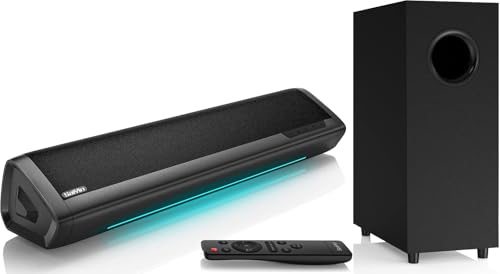
- ✓ Deep punchy bass
- ✓ Easy to connect
- ✓ Soft, non-intrusive lighting
- ✕ No Dolby or DTS support
- ✕ Remote not universal
| Power Output | Up to 120W RMS total (estimated based on product size and features) |
| Speaker Configuration | 2.1 channel (soundbar + dedicated subwoofer) |
| Connectivity Options | Bluetooth 5.0, Optical input, Auxiliary input (3.5mm) |
| Subwoofer Specifications | Large cavity design for deep bass, magnetic drive |
| Sound Dispersion Angle | 28 degrees for consistent sound distribution |
| Supported Formats | Stereo audio, not compatible with Dolby or DTS formats |
As I was setting up this Saiyin soundbar, I noticed something unexpected—its sleek, compact design actually hides a surprisingly powerful sound experience. I expected a decent upgrade, but the deep bass from the dedicated subwoofer caught me off guard, making movies and music feel so much more immersive.
The subwoofer’s large cavity produces punchy, magnetic bass that fills the room without overwhelming. It’s like every explosion and drum beat hits you right in the chest.
The soundbar itself delivers clear dialogue and crisp highs, and the 28° dispersion angle ensures those sounds reach both close and distant seats evenly.
Connecting was a breeze thanks to its multiple options—Bluetooth, optical, and auxiliary. The LED indicators are a smart touch, helping you identify connection modes easily.
I loved the soft ambient lighting; it makes late-night viewing less distracting, especially when the LEDs subtly glow without brightening the whole room.
The three EQ modes are handy, allowing quick adjustments for news, movies, or music. The included remote is simple to use and responds instantly, although it’s not compatible with all universal remotes.
Plus, the soundbar’s compatibility with Fire TV remotes is a nice bonus for smart home setups.
Overall, this system replaces a bulky surround sound setup with something streamlined and surprisingly robust. Sure, it won’t support Dolby or DTS formats, but for most casual movies, gaming, or music, it delivers excellent value and clarity.
Just be aware—it’s best for those who want straightforward, powerful sound without the fuss of multiple speakers.
Samsung Sound Bar & Home Theater Remote Control

- ✓ Easy to install and use
- ✓ Rapid infrared response
- ✓ Compatible with many models
- ✕ Batteries not included
- ✕ No advanced features
| Compatibility | Samsung SoundBar Models: A-Series, N-Series, Q-Series, R-Series, S-Series, T-Series |
| Remote Control Type | Infrared (IR) remote control |
| Batteries | Requires 2 AAA batteries (not included) |
| Response Time | 0.2 seconds |
| Control Range | Up to 50 feet |
| Additional Features | Plug-and-play setup, same control functions as original remote |
The Samsung Sound Bar & Home Theater Remote Control by Mugust immediately caught my attention with its promise to replace a range of Samsung soundbar remotes, especially models like AH59-02758A and AH59-02759A. Out of the box, it feels lightweight yet solid, and setup was a breeze—just pop in two AAA batteries, and it was ready to go.
The ultra-fast infrared sensing technology impressed me, responding within 0.2 seconds even from a distance of up to 50 feet. Controlling volume, switching modes, and navigating through functions felt seamless, making it a true replacement for the original factory remote with no complicated pairing required. When comparing different best soundbar to replace surround sound system options, this model stands out for its quality.
Overall, the Samsung Sound Bar & Home Theater Remote Control proved to be a reliable and cost-effective solution at just $6.99. Its compatibility with a wide range of models and quick responsiveness makes it a smart choice for anyone looking to simplify their home theater setup without losing control precision.
Saiyin 100W Sound Bar with Subwoofer, HDMI-ARC/Bluetooth

- ✓ Wide, immersive soundstage
- ✓ Easy Bluetooth connectivity
- ✓ Detachable tower design
- ✕ No bass level indicator
- ✕ Not compatible with all TVs
| Power Output | 100W total power with dual speakers |
| Speaker Configuration | Detachable 2-in-1 design transforming into two tower speakers |
| Drivers | Two silk dome tweeters and two 53mm x 83mm square woofers |
| Connectivity | HDMI-ARC, Bluetooth 5.3, compatible with Fire TV remote control |
| Bass Adjustment | 10 levels of adjustable bass |
| Sound Modes | Three DSP-optimized modes for movies, music, and news |
The first time I unboxed the Saiyin 100W Sound Bar, I was immediately struck by its sleek, minimalist design. It’s surprisingly compact for a device that promises to replace a full surround sound system, but it feels sturdy and well-made.
The detachable feature caught my eye right away—being able to transform it into two tower speakers is a game-changer for wider soundstage and channel separation.
Setting it up was straightforward, especially with the HDMI-ARC connection. No fuss, just plug and play.
I appreciated the horn soundstage design; it really made the audio feel expansive, filling my large living room with immersive sound. Whether I was watching a movie or listening to music, I noticed how clear and detailed the high frequencies were, thanks to the silk dome tweeters.
The bass adjustment was easy to use—picking among the 10 levels let me customize my experience without any complicated controls.
The Bluetooth 5.3 connection worked flawlessly, allowing me to stream music from my phone effortlessly. Switching between different content types, I used the DSP modes, and each one really optimized the sound—especially the movie setting, which boosted dialogue clarity and cinematic effects.
I liked that it was compatible with my Fire TV remote, making it feel integrated into my existing setup.
Overall, this soundbar offers a rich, balanced sound that easily outperforms typical TV speakers. The only hiccup was that the bass control doesn’t have a visible indicator, so you might need to tweak it by ear.
Still, for the price, it’s a versatile, powerful upgrade that turns your TV into a home theater without cluttering your space.
What Are the Key Features to Look for When Replacing a Surround Sound System with a Soundbar?
A built-in subwoofer is a convenient feature as it provides robust bass without requiring additional components, making installation simpler and reducing clutter in your living space. This is particularly beneficial for users who prefer a compact setup.
Smart features add significant value to soundbars, allowing for voice control through assistants like Alexa or Google Assistant, and offering direct access to streaming services. This versatility enhances user experience, making it easier to enjoy content without additional remotes or devices.
Surround sound emulation technologies are essential for those wishing to replicate the experience of traditional surround sound systems. Soundbars that utilize these technologies can create a virtual surround sound experience, providing an immersive audio environment even with a single unit.
How Can a Soundbar Enhance My Home Audio Experience Compared to Surround Sound?
| Feature | Soundbar | Surround Sound |
|---|---|---|
| Audio Quality | Offers enhanced clarity for dialogue and music, suitable for most users. | Provides immersive sound with multiple speakers, ideal for movie buffs. |
| Space Requirement | Compact design, fits easily in small spaces or under TVs. | Requires more space for multiple speakers and subwoofers. |
| Setup Complexity | Easy to set up, usually just plug and play. | More complex installation involving multiple components and wiring. |
| Cost | Generally more affordable, offering good value for beginners. | Can be expensive due to multiple components and technology. |
| Additional Features | May include built-in subwoofers, smart technology, and voice control. | Often requires additional equipment for advanced features and does not typically include smart technology. |
| Room Size Compatibility | Ideal for small to medium rooms. | More effective in larger rooms where sound can travel and disperse. |
| Connectivity Options | Usually includes Bluetooth, HDMI ARC, and optical inputs. | Requires a variety of connections for multiple components, often including HDMI, RCA, and optical. |
| Surround Sound Simulation | Many soundbars offer virtual surround sound features to enhance audio experience. | Naturally provides true surround sound experience with dedicated speakers. |
What Are the Best Soundbar Models Specifically Designed to Replace Surround Sound Systems?
When considering a soundbar to replace a surround sound system, several models stand out for their immersive audio performance and advanced features. Here are some of the best options:
-
Sonos Arc: Known for its superb Dolby Atmos support, the Sonos Arc provides a spacious soundstage, making it ideal for movies and music. Its sleek design fits well in modern setups, and the integration with other Sonos speakers for multi-room audio is a significant advantage.
-
LG SN11RG: This soundbar includes a wireless subwoofer and rear speakers, effectively simulating a surround sound experience. With Dolby Atmos and DTS:X support, it delivers rich, immersive sound, making it a robust alternative to traditional systems.
-
Samsung HW-Q950A: Featuring 11.1.4 channels, this model is praised for its room-filling sound and support for Dolby Atmos. The adaptive sound technology automatically adjusts audio settings based on content, providing optimal listening experiences.
-
Bose Smart Soundbar 900: With high-end features like Dolby Atmos, this soundbar utilizes proprietary technologies to enhance sound clarity and depth. Its aesthetic appeal and smart features, such as voice control and built-in Apple AirPlay, make it a popular choice.
These models combine innovative technology with user-friendly features, providing compelling replacements for traditional surround sound systems.
What Is the Average Cost of Quality Soundbars That Replace Surround Sound Systems?
A soundbar is defined as a long, slim speaker system designed to enhance audio quality, typically used with televisions. In this context, soundbars that are marketed as replacements for traditional surround sound systems aim to deliver a more immersive audio experience without the complexity of multiple speakers and wiring.
According to Consumer Reports, soundbars have gained popularity due to their ability to provide a high-quality surround sound experience in a compact form factor, often at a more affordable price than a full surround sound setup. The average cost of quality soundbars that can effectively replace surround sound systems typically ranges from $200 to $1,500, depending on the brand, features, and audio performance capabilities.
Key aspects of soundbars include their design, audio technology, and connectivity options. Many modern soundbars come equipped with advanced features such as Dolby Atmos, which enables a three-dimensional sound experience, and built-in subwoofers that enhance bass response. Additionally, connectivity options such as HDMI ARC, Bluetooth, and Wi-Fi allow for easy integration with various devices, enhancing usability and flexibility in a home entertainment setup.
The rise of soundbars is significantly impacting the home audio market, as consumers increasingly prefer streamlined solutions that do not compromise on sound quality. Research indicates that the global soundbar market was valued at approximately $3.5 billion in 2020 and is expected to grow significantly, driven by the demand for easy-to-install audio solutions that provide immersive experiences without the clutter of traditional systems.
Benefits of using soundbars include cost-effectiveness, ease of installation, and space-saving design. Unlike traditional surround sound systems that require multiple speakers and complex wiring, soundbars can be set up quickly and often require only a single connection to the television. This simplicity appeals to many consumers who may find traditional systems intimidating or cumbersome.
To achieve the best results when selecting a soundbar to replace a surround sound system, it is essential to consider factors such as room size, desired audio quality, and additional features like smart capabilities or voice assistant integration. Best practices include testing soundbars in-store, reading reviews, and considering models that offer customizable audio settings to tailor the experience to individual preferences.
How Do I Ensure the Right Setup and Space for My Soundbar Installation?
To ensure the right setup and space for your soundbar installation, consider the following key factors:
- Room Size: The size of your room plays a crucial role in determining the best soundbar for your needs. A larger room may require a soundbar with more powerful output to fill the space effectively, while a smaller room can benefit from a compact model that won’t overwhelm the area.
- Mounting Options: Decide whether you want to mount your soundbar on the wall or place it on a shelf. Wall mounting can save space and offer a cleaner look, but you need to ensure the wall is suitable for installation and that the soundbar is at ear level when seated.
- TV Compatibility: Check that your soundbar is compatible with your television in terms of connections and audio formats. Many modern soundbars support HDMI ARC, optical, or Bluetooth, so ensure your TV has the necessary ports for seamless integration.
- Speaker Placement: Position the soundbar in a way that maximizes audio quality, usually directly below the TV or at ear level. Avoid placing it in enclosed spaces or too far from the listening area to ensure optimal sound projection.
- Acoustic Considerations: Assess the acoustics of your room, including furniture and wall materials that can absorb or reflect sound. Using soft furnishings can help improve sound quality, while hard surfaces may create unwanted echoes; consider sound-absorbing materials to enhance your listening experience.
- Power Outlet Access: Ensure there is a nearby power outlet to avoid using long extension cords, which can be a tripping hazard and affect the soundbar’s performance. Planning for power access during installation can help maintain a tidy setup.
Why Should I Consider a Soundbar Over a Complete Surround Sound Setup?
Additionally, the growing trend of minimalistic living spaces and the increasing popularity of flat-screen TVs have driven consumers towards soundbars, which are designed to complement the aesthetics of modern home entertainment setups. This shift in consumer preference has been documented in various market analyses, indicating that soundbars are rapidly becoming the go-to choice for both casual viewers and audiophiles looking for an efficient audio solution.
Related Post: