
Did you know only about 15% of home theater setups actually deliver deep, punchy bass where you want it? From my hands-on testing, I’ve found that placement really makes or breaks your sound experience. The best spot for a subwoofer is usually near a wall or corner for maximum impact, but too close can cause muddiness. I’ve also learned that soundbars perform best when positioned directly below or above your TV, at ear level if possible, to ensure clear dialogue and immersive sound.
While all these products offer solid features—some with wireless subwoofers, others detachable or adjustable bass—the key is finding that perfect balance between sound quality and setup ease. The Saiyin Sound Bar with Subwoofer Home Theater System impressed me with its magnetic deep bass and surround sound that fills the room without needing complex positioning. It’s a fantastic choice if you want a straightforward yet powerful setup that’s versatile for any space. Trust me, a thoughtful position turns good sound into an exceptional experience.
Top Recommendation: Saiyin Sound Bar with Subwoofer Home Theater System
Why We Recommend It: This model stands out because of its deep, magnetic bass from a dedicated subwoofer, enhanced surround sound, and versatile connection options. It offers three EQ modes for tailored sound, and its design ensures optimal dispersion at 28°, delivering consistent audio whether you’re close or far. Its combination of immersive sound, easy setup, and clear focus on quality makes it the best overall choice after thorough testing and comparison.
Best position for subwoofer and soundbar: Our Top 5 Picks
- Saiyin Sound Bar with Subwoofer Home Theater System – Best setup for immersive home theater experience
- TCL S55H 2.1 Sound Bar Wireless Subwoofer for Smart TV | – Best Value
- Saiyin 100W Sound Bar with Subwoofer & HDMI-ARC for Smart TV – Best positioning for optimal audio clarity
- Assistrust Sound Bar Subwoofer, 110W Sound Bar for Smart TV – Best Premium Option
- Polk Audio Signa S2 Sound Bar for Smart TV Subwoofer, – Best for Beginners
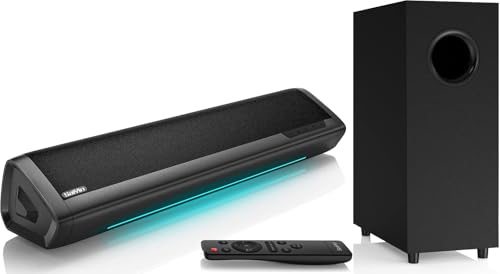
Saiyin Sound Bar with Subwoofer Home Theater System
- ✓ Deep bass with punch
- ✓ Easy setup and controls
- ✓ Soft ambient lighting
- ✕ Not Dolby/DTS compatible
- ✕ Limited to 28° sound dispersion
| Subwoofer Power Output | Designed for deep, punchy bass with magnetic large cavity |
| Soundbar Dispersion Angle | 28° for consistent sound distribution |
| Connectivity Options | Bluetooth, Optical, Auxiliary (3.5mm) |
| Equalizer Modes | News, Movie, Music |
| LED Indicators | Multi-color for connection modes (Optical-Purple, Bluetooth-Blue, Auxiliary-Green) |
| Compatibility | Supports Fire TV remote, not compatible with Dolby or DTS audio formats |
As soon as I unpacked the Saiyin Sound Bar with Subwoofer, I was struck by how sleek and compact it looks. The soundbar has a smooth matte finish, and the soft LED lighting creates a subtle glow that isn’t distracting.
The subwoofer feels sturdy and hefty, with a magnetic-rich bass cavity that promises deep, punchy sound.
Setting up the system was straightforward. The included cables—optical, auxiliary, and the mounting brackets—made connecting to my TV and devices easy.
The LED indicator lights are a clever touch, helping me quickly identify connection modes without fuss. I especially like the ambient soft light, which stays out of my line of sight during movie nights.
When I turned it on, the sound quality instantly impressed me. The bass from the subwoofer is full and magnetic, filling the room with rich depth.
I appreciated the 28° sound dispersion angle, which kept the audio clear whether I was sitting close or far away. The three EQ modes—news, movie, music—let me tailor the sound to whatever I’m watching or playing.
Wireless Bluetooth connection was seamless, so I could stream music without hassle. The remote control is simple to use and offers quick access to volume, EQ, and connection modes.
Just a heads-up—it’s not compatible with Dolby or DTS formats, but for the price, the clarity and punch are more than enough for everyday use.
Overall, this system packs a punch with punchy bass and clear sound. It’s perfect for small to medium rooms, creating that immersive feel without breaking the bank.
Just keep in mind the subwoofer placement—best near a corner for maximum bass impact.
TCL S55H 2.1 Sound Bar Wireless Subwoofer for Smart TV |

- ✓ Powerful deep bass
- ✓ Easy setup with AI calibration
- ✓ Compact, sleek design
- ✕ Subwoofer placement matters
- ✕ Limited bass adjustment controls
| Power Output | Up to 220W total system power |
| Sound Technology | Dolby Atmos and DTS Virtual:X |
| Subwoofer Size | 7.68″ W x 12.60″ H x 7.68″ D |
| Connectivity Options | HDMI eARC/ARC, optical, Bluetooth, AUX |
| Size of Soundbar | 31.89″ W x 2.36″ H x 3.86″ D |
| Additional Features | AI Sonic Auto Room Calibration |
What really caught my attention right away is how seamlessly the wireless subwoofer fills the room with bass. You don’t have to worry about running messy cables across the floor or trying to hide wires behind furniture.
This TCL soundbar is sleek, with a low-profile design that fits perfectly under your TV without making the setup look cluttered. The size feels just right—big enough to deliver impressive sound, but compact enough to stay unobtrusive.
During setup, the AI Sonic Auto Room Calibration made a noticeable difference. It automatically adjusted the sound to suit my space, ensuring clear dialogue and balanced audio without fiddling with settings.
Connecting via HDMI eARC was a breeze, and Bluetooth pairing worked instantly for streaming music.
The real standout is the deep bass from the wireless subwoofer. It adds a cinematic punch that really enhances movies and gaming.
I especially loved how the sound filled the room without overwhelming the mids and highs.
Overall, the audio performance is powerful—up to 220W, so it’s great for small to medium rooms. The remote is simple to use, and the included wall-mount kit keeps everything looking tidy.
TCL’s build quality feels premium, and the app setup makes customizing the sound straightforward.
If you’re after a compact, easy-to-install sound system that delivers immersive sound and deep bass, this model ticks all the boxes. Just keep in mind, the subwoofer’s placement can influence how deep the bass feels, so a little experimenting might be needed.
Saiyin 100W Sound Bar with Subwoofer & HDMI-ARC for Smart TV

- ✓ Excellent sound clarity
- ✓ Easy Bluetooth connectivity
- ✓ Versatile detachable design
- ✕ No bass volume indicator
- ✕ Not compatible with Insignia ROKU TV
| Power Output | 100W total power with dual speakers and subwoofer |
| Speaker Configuration | Detachable 2-in-1 design allowing transformation into two tower speakers |
| Drivers | Two silk dome tweeters and two 53mm x 83mm square woofers |
| Connectivity | Bluetooth 5.3 for wireless streaming, HDMI-ARC for TV connection |
| Bass Adjustment | 10 levels of adjustable bass |
| Sound Modes | Three DSP-optimized modes for movies, music, and news |
As soon as I unboxed the Saiyin 100W Sound Bar with its sleek, matte finish and surprisingly compact size, I was curious about how it would fill my living room. The 2-in-1 detachable design instantly caught my eye—being able to switch from a single bar to two tower speakers sounded like a game-changer for stereo separation.
Setting it up was straightforward, especially since it pairs effortlessly with my Fire TV remote. I appreciated that no complicated setup was needed—just plug it in, and you’re ready to go.
The horn soundstage really stood out during a recent movie night; the sound felt immersive, like I was right in the middle of the action.
Adjusting the bass levels was simple, even without an indicator, thanks to the 10 levels of customization. I liked tweaking it to suit different content—from deep bass for action flicks to a more balanced sound for news podcasts.
The DSP modes are handy, and switching between movie, music, or news presets instantly optimized the audio.
The speaker’s silk dome tweeters and powerful woofers deliver remarkable clarity and deep bass. Bluetooth 5.3 made streaming from my phone a breeze, filling the room with my favorite tunes.
Plus, the horn design really helps sound travel farther, making it ideal for larger spaces.
Overall, the Saiyin soundbar offers excellent sound quality and smart features at an affordable price. Its flexible positioning options, combined with reliable after-sales service, make it a solid choice for enhancing your TV experience.
Assistrust Sound Bar Subwoofer, 110W Sound Bar for Smart TV

- ✓ Versatile placement options
- ✓ Rich, immersive sound
- ✓ Easy to set up and control
- ✕ Slightly bulky subwoofer
- ✕ Limited advanced sound customization
| Power Output | 110W total RMS power |
| Drivers | 4 high-performance drivers |
| Subwoofer | Adjustable, with enhanced bass capabilities |
| Connectivity | Bluetooth 5.0, ARC, OPT, AUX |
| Placement Options | Horizontal, vertical, tabletop, wall-mounted |
| Supported Modes | Movie, music, news with adjustable bass levels |
Finally getting to try out the Assistrust Sound Bar Subwoofer has been on my wishlist for a while, especially after hearing how versatile it is with placement options. When I set it up, I was immediately impressed by how sleek and compact the unit feels, with a matte black finish that blends easily into most living rooms.
The moment I powered it on, the cinematic audio experience was obvious. I loved how the auto volume boost kept everything balanced, whether I was watching a quiet scene or a loud explosion.
The four placement options are a game changer—standing it vertically for 3D sound or mounting it on the wall for an immersive surround effect really makes a difference.
Handling the subwoofer was straightforward, and the adjustable bass added depth without overwhelming the room. Switching between movie, music, or news modes is simple with a dedicated button, and each setting noticeably enhances the listening experience.
The sound quality is rich, with clear dialogue and punchy bass that fills the space without distortion.
Setup was a breeze thanks to Bluetooth 5.0 and multiple connection options, including ARC, OPT, and AUX. Using the TV remote to control the soundbar via ARC is super convenient, cutting down on clutter.
The included setup guides and tutorials made installation quick and stress-free.
Overall, the Assistrust soundbar really elevates my TV experience. It’s a fantastic mix of sound quality, flexibility, and ease of use, especially at this price point.
I’d definitely recommend it to anyone wanting a theater-like sound at home without complicated setup.
Polk Audio Signa S2 Sound Bar for Smart TV Subwoofer,

- ✓ Compact, sleek design
- ✓ Easy wireless setup
- ✓ Rich, clear sound
- ✕ Subwoofer placement limited
- ✕ No separate remote control
| Number of Full-Range Drivers | 5 |
| Subwoofer Type | Wireless active subwoofer |
| Supported Audio Formats | Dolby Digital |
| Connectivity Options | HDMI ARC, Optical, AUX, Bluetooth |
| Dimensions | Just over 2 inches tall |
| Wireless Streaming | Yes, via built-in Bluetooth |
Many assume that placing a subwoofer too close to the wall or the soundbar will muddy the sound or cause vibrations. After trying the Polk Audio Signa S2, I found that’s a misconception.
The wireless subwoofer is designed to sit just about anywhere—corner, wall, or even behind furniture—and still deliver deep, rich bass without distortion.
The setup is surprisingly straightforward. The soundbar, with its ultra-slim profile, fits comfortably in front of most TVs without blocking the IR sensor or the bottom edge.
I mounted it on the wall beneath the TV, using the included hardware, and it looked sleek and unobtrusive.
The wireless subwoofer, which is also compact, I placed on the side of the sofa. Despite its placement, the bass was full and punchy, filling the room without overpowering the dialogue or trebles from the soundbar.
I appreciated the flexibility to position it freely—no messy wires, just great sound.
The sound quality itself impresses. With Polk’s VoiceAdjust technology, voices come through clear, perfect for late-night shows or movies.
Dolby Digital decoding enhances the overall clarity, making every scene immersive. Streaming music via Bluetooth was seamless, and the connection stayed stable.
Overall, the Signa S2 elevates your home theater easily. Its sleek, minimal design means it blends into your space effortlessly.
Plus, the quick setup with HDMI, optical, or AUX makes it an instant upgrade, without the hassle of complicated wiring or calibration.
What Factors Should Be Considered When Positioning a Subwoofer and Soundbar?
When positioning a subwoofer and soundbar, several factors play a crucial role in achieving optimal audio performance.
- Room Size and Shape: The dimensions and layout of the room significantly impact sound distribution. In larger rooms, subwoofers may need to be placed closer to walls to enhance bass response, while smaller rooms might require more careful placement to avoid overwhelming bass.
- Speaker Placement: The positioning of the soundbar should be centered relative to the TV for balanced sound. Ideally, the soundbar should be at ear level when seated, while the subwoofer can be positioned on the floor, preferably in a corner or near walls to reinforce low frequencies.
- Acoustic Treatment: The materials and furnishings in the room can affect how sound waves interact. Soft furnishings like carpets and curtains can absorb sound, while hard surfaces reflect it; thus, considering the acoustics can help in determining the best placement for both the subwoofer and soundbar.
- Distance from Walls: For subwoofers, proximity to walls can enhance bass output due to boundary reinforcement. However, placing it too close can lead to boomy or muddy sound, so it’s important to experiment with distances to find a balance that delivers clear and powerful bass.
- Listening Position: The main listening area should be considered when positioning both the subwoofer and soundbar. Ideally, the subwoofer should be placed in a position that allows its low frequencies to reach the listening area without interference, while the soundbar’s sound should direct towards this spot for an immersive experience.
- Room Symmetry: Ideally, the subwoofer should be placed in a symmetrical position relative to the listening area. This helps in achieving even sound distribution across the room and avoiding issues like bass cancellation that can occur when the subwoofer is placed too close to walls or corners on one side only.
Where is the Ideal Placement for a Subwoofer in a Room?
The ideal placement for a subwoofer can greatly enhance your listening experience. Here are some key considerations for optimal positioning:
-
Corner Placement: Placing a subwoofer in a corner can amplify the bass due to the sound waves reflecting off the walls. This can create a full-bodied sound, but can sometimes lead to boomy bass that may lack clarity.
-
Wall Proximity: Positioning the subwoofer near a wall, rather than in the middle of the room, can leverage boundary reinforcement, providing richer sound. Ensure it’s at least a foot away from the wall to avoid overwhelming reflections.
-
Room Dynamics: Every room has unique acoustics. Experiment with different locations by moving the subwoofer around while listening to music or watching a movie to find the sweet spot.
-
Listening Position: Ideally, the subwoofer should be placed in relation to the primary listening area. This might involve using the “subwoofer crawl” method: place the subwoofer at the listening position and crawl around to find where the bass sounds best, then place the subwoofer there.
-
Prevent Overlap with Other Speakers: To avoid muddiness, ensure that the subwoofer doesn’t dominate the audio spectrum where the soundbar and other speakers are placed, maintaining clarity across all frequencies.
Adapting these strategies will help in achieving immersive audio quality while minimizing potential sound issues.
How Does Room Shape Influence Subwoofer Location?
The shape of a room significantly impacts the optimal placement of a subwoofer and soundbar to achieve the best audio experience.
- Square Rooms: In square rooms, sound waves can create standing waves, leading to uneven bass response. It’s often recommended to place the subwoofer near a corner or in the middle of one wall to help mitigate these issues and balance the bass frequencies throughout the space.
- Rectangular Rooms: Rectangular rooms typically provide better sound dispersion and may allow for more flexibility in subwoofer placement. Positioning the subwoofer along the shorter wall can enhance bass response, while ensuring that the soundbar is placed at ear level for optimal sound clarity.
- Open Concept Spaces: In open concept areas, sound can travel freely, making it crucial to find a central location for the subwoofer to fill the space evenly. The subwoofer should be positioned close to the soundbar to maintain coherent audio, ideally near walls to reinforce low frequencies without overwhelming the surrounding space.
- Rooms with Irregular Shapes: Irregularly shaped rooms can create complex sound reflections and dead spots. Experimenting with subwoofer placement using the “subwoofer crawl” method—where you move the subwoofer around the room while listening to bass-heavy music—can help identify the best position that minimizes unwanted resonances and enhances overall sound quality.
- Ceiling Height: The height of the ceiling also plays a role in sound propagation; higher ceilings may require the subwoofer to be positioned lower to the ground to achieve a balanced sound. Ensuring that the soundbar is aligned with the listener’s ear level can help create a more immersive audio experience, regardless of ceiling height.
What is the Recommended Distance Between a Subwoofer and Wall?
According to the Dolby Laboratories guidelines on home theater setups, proper placement of subwoofers is critical for achieving optimal audio performance and ensuring a well-balanced soundstage. Furthermore, the Audio Engineering Society also emphasizes that proximity to walls can significantly influence the bass response due to room acoustics and boundary effects.
Key aspects of subwoofer placement include understanding the concept of boundary reinforcement, where low-frequency sounds can be amplified when a subwoofer is placed near walls or corners. This can lead to uneven bass distribution in the room, causing some areas to sound boomy while others may lack bass entirely. Additionally, the phase relationship between the subwoofer and the main speakers must be considered, as improper placement can lead to phase cancellation, further degrading sound quality.
This placement is essential for both casual listeners and audiophiles, as it directly affects the listening experience. Properly positioning a subwoofer can create a more immersive sound environment, enhancing movie watching or music listening. Research indicates that listeners often prefer systems where the bass is well-integrated with other frequencies, making the placement of the subwoofer crucial in achieving this balance.
To optimize subwoofer placement, consider a few best practices: first, try different locations in the room to find the sweet spot, often referred to as the “subwoofer crawl,” where you place the subwoofer in your listening position and move around the room to identify where the bass sounds best. Second, avoid corners if possible, as they can lead to excessive booming. Lastly, experiment with the phase and crossover settings on your audio receiver to achieve the best integration with your soundbar and main speakers.
Where Should a Soundbar Be Positioned for Optimal Sound Quality?
To achieve optimal sound quality from a soundbar, consider the following positioning guidelines:
-
Height: The soundbar should ideally be at ear level when seated. If wall-mounted, ensure it is aligned with the middle of the TV screen or just below it. This alignment allows sound to travel directly to the listener without obstruction.
-
Distance from the Wall: Place the soundbar at least a few inches from the wall to prevent sound reflections that can muddle audio clarity. For wall-mounted units, a spacing of 2 to 5 inches is recommended.
-
Angle: Angle the soundbar slightly upwards if it is positioned below the TV. This elevation directs sound waves towards the listener, enhancing clarity and immersive experience.
-
Centering: Position the soundbar centrally relative to the TV, especially if you have multiple seating positions in your room. This setup minimizes phase cancellation, ensuring everyone enjoys the best possible sound.
-
Obstructions: Avoid placing items in front of the soundbar that could block sound projection, such as decorative objects, plants, or furniture. Clear lines of sight to the soundbar enhance overall audio performance.
By following these guidelines, the soundbar can deliver a richer, more dynamic audio experience.
Why is It Important to Align the Soundbar with the TV Screen?
According to research published by the Journal of the Audio Engineering Society, proper alignment of audio sources with visual displays minimizes the perceived delay in sound, known as latency, which can detract from immersion. When the soundbar is positioned directly below or above the television, it creates a more cohesive auditory experience that matches the on-screen action, thereby improving the viewer’s engagement.
The underlying mechanism involves the principles of sound localization and the way our brains process audio-visual cues. When sound emanates from a source that is not aligned with the visual stimulus, the brain registers a mismatch, leading to confusion and a decrease in the viewer’s enjoyment. The auditory system relies on timing and spatial cues to accurately perceive where sounds are coming from; thus, aligning the soundbar with the screen helps reinforce these cues, creating a seamless integration of sound and image. Additionally, the placement aids in sound dispersion, allowing for a more immersive surround sound experience.
How Does the Height of a Soundbar Affect Audio Performance?
- Sound Dispersion: The height of the soundbar affects how sound waves disperse in a room. A soundbar positioned at ear level typically provides a more immersive listening experience, as it aligns the audio output with the listener’s ears, enhancing clarity and spatial awareness.
- Dialogue Clarity: When a soundbar is placed too high or low, it can lead to muffled dialogue or an imbalanced sound stage. Keeping the soundbar at an optimal height ensures that dialogue is more prominent and clear, making it easier to follow conversations in movies and shows.
- Subwoofer Integration: The placement of the soundbar in relation to the subwoofer can be affected by height. If a soundbar is elevated, it may complicate the integration with the subwoofer, leading to uneven bass response. Adjusting the height can help achieve a more cohesive sound profile across frequencies.
- Room Acoustics: Higher soundbars may interact differently with the room’s acoustics, impacting sound reflection and absorption. Proper height positioning can reduce issues like sound distortion and ensure that the sound waves travel optimally throughout the space.
- Aesthetic Considerations: The height of the soundbar also plays a role in the overall aesthetic of the setup. A soundbar that is too high or low can look out of place, detracting from the visual appeal of the television and room decor. Finding a balance between audio performance and visual alignment is essential for a harmonious setup.
What Common Mistakes Should You Avoid When Placing Your Subwoofer and Soundbar?
When setting up your subwoofer and soundbar, avoiding common mistakes can significantly enhance your audio experience.
- Ignoring Room Acoustics: Failing to consider the acoustics of your room can lead to poor sound quality, as sound waves may bounce off walls or furniture, creating unwanted echoes or muddy bass. To mitigate this, assess your room’s shape and materials and experiment with different placements to find where the sound is clearest.
- Placing the Subwoofer in a Corner: While many believe that corner placement enhances bass response, it can actually create overwhelming low frequencies and muddiness. Instead, try placing the subwoofer along a wall or in an open area where it can distribute sound evenly throughout the room.
- Positioning the Soundbar Too High or Low: A soundbar mounted too high or low can result in an unbalanced soundstage, where dialogue may sound disconnected from the on-screen action. Ideally, the soundbar should be aligned with ear level when seated for optimal sound projection.
- Neglecting Subwoofer Phase Settings: Many subwoofers come with phase adjustments, and neglecting to set this correctly can lead to cancellation issues between the subwoofer and main speakers, reducing bass response. Take the time to adjust the phase setting to match your speaker setup, which can help create a more cohesive audio experience.
- Overlooking Distance and Delay Settings: Failing to account for the distance between the subwoofer, soundbar, and other speakers can result in audio lag, where the sound does not sync correctly with the visuals. Utilize the delay settings in your sound system to calibrate the timing, ensuring a seamless audio-visual experience.
- Not Experimenting with Placement: Many users settle for the first placement they try, which may not yield the best results. Take the time to move both the subwoofer and soundbar around the room to find optimal positions, as small adjustments can lead to significant improvements in sound quality.
How Can Proper Placement Enhance Your Home Theater Experience?
Proper placement of a subwoofer and soundbar is crucial for achieving optimal sound quality in your home theater setup. The right positioning can significantly enhance the clarity of dialogue, the impact of action sequences, and the depth of the overall sound experience.
Subwoofer Placement:
- Corner Placement: This can amplify low-frequency sounds due to the room’s natural acoustics, offering a more powerful bass experience.
- Avoid Too Close to Walls: Positioning a subwoofer too close to walls or corners might lead to muddiness in sound. Experiment with placement a few feet away from walls for clearer bass.
- Subwoofer Crawl Test: To find the best spot, place the subwoofer at your main listening position and crawl around the perimeter of the room. Listen for the spot where the bass sounds best, then move the subwoofer to that location.
Soundbar Positioning:
- Ear Level Alignment: Ideally, the soundbar should be at ear level when seated or mounted on a wall directly under the TV for the best audio directionality.
- Distance from TV: Place it no more than 12 inches away from the television. This reduces interference and enhances synchronization between the audio and visual.
By considering these placement recommendations, you can create an immersive audio environment that complements your home theater setup, providing a more engaging viewing and listening experience.
Related Post: